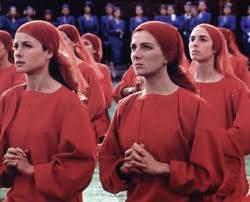
 The Handmaid's outfit is all red which I think symbolizes energy, desire, and love. People generally are attracted to red clothing. For example we see this with Offred when Luke stares and winks at her. It might symbolize attraction and want. Their outfit is very significant to this story because it suggest uniform and a dystopian society. It also suggests the blood of the menstrual cycle and childbirth. Within Chapter 5-8 we are introduced to the Wall a very symbolic object where dissidents are executed and hung up on outer walls of the university as a warning to people in Gilead what their actions can cause. There daily duties are the same every day. They serve their commander and follow rules. The Handmaids are very similar to the flowers Offred describes several times in the book. She emphasizes how a Handmaid is like a flower where they have been cut of from the sexual influences of the world. Like when Offred cuts of the sexual organs of the flower. In Chapter 5 we have a lady who is pregnant that makes all the girls very jealous. Offred cannot help but stare at this heavily pregnant lady.
I find interesting that people in this society have everything hidden and don't show there real selves. Woman get jealous like every human does. Woman here also find it very hard to control themselves and their feelings. Many just want to turn against woman. Handmaid's social function is to bear children for Wives.
The Handmaid's outfit is all red which I think symbolizes energy, desire, and love. People generally are attracted to red clothing. For example we see this with Offred when Luke stares and winks at her. It might symbolize attraction and want. Their outfit is very significant to this story because it suggest uniform and a dystopian society. It also suggests the blood of the menstrual cycle and childbirth. Within Chapter 5-8 we are introduced to the Wall a very symbolic object where dissidents are executed and hung up on outer walls of the university as a warning to people in Gilead what their actions can cause. There daily duties are the same every day. They serve their commander and follow rules. The Handmaids are very similar to the flowers Offred describes several times in the book. She emphasizes how a Handmaid is like a flower where they have been cut of from the sexual influences of the world. Like when Offred cuts of the sexual organs of the flower. In Chapter 5 we have a lady who is pregnant that makes all the girls very jealous. Offred cannot help but stare at this heavily pregnant lady.
I find interesting that people in this society have everything hidden and don't show there real selves. Woman get jealous like every human does. Woman here also find it very hard to control themselves and their feelings. Many just want to turn against woman. Handmaid's social function is to bear children for Wives.
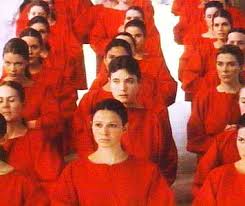 Through out the Chapters 1-4 the lives of woman are strictly ruled and we find out later in the chapter that the narrators name is Offred. Woman are not allowed to talk to each other but they communicate through whispering and body languages. Two woman in authority of them are Aunt Elizabeth and Sara. Marthas wear green uniforms and Wives wear blue uniforms and the woman in red are handmaids. Strange huh? This all goes back to the term we discussed in class called dystopia. A dystopia is a community that is frightnening and undesirable like this society for example.
The story starts out with unfamiliar names such as Angels, Commanders, and Handmaid. Woman hear there names and are reminded that they are no more than a company. Offred no longer has a family nor kids. She has flashbacks to and from the past. Offren works as a handmaid at the household of the Commander and Serena Joy where in chapter 3 where Offren looks around for the Commander's Wife and does not see her but she notices the garden. She uses tons of imagery to emphasize her feelings towards it. She wonders if scarves ever get used. Why do Wives do so much knitting?
I found interesting that men in this society like Luke for example don't go by the rules. He winks at Offred therefore disobeying the rules to not talking to woman. Offred also does what she is not supposed to and flirts with some young Guardians by making eye contact and cherishing his body language. Also we see the word "Handmaid" used in Chapter 4 for the first time.
Through out the Chapters 1-4 the lives of woman are strictly ruled and we find out later in the chapter that the narrators name is Offred. Woman are not allowed to talk to each other but they communicate through whispering and body languages. Two woman in authority of them are Aunt Elizabeth and Sara. Marthas wear green uniforms and Wives wear blue uniforms and the woman in red are handmaids. Strange huh? This all goes back to the term we discussed in class called dystopia. A dystopia is a community that is frightnening and undesirable like this society for example.
The story starts out with unfamiliar names such as Angels, Commanders, and Handmaid. Woman hear there names and are reminded that they are no more than a company. Offred no longer has a family nor kids. She has flashbacks to and from the past. Offren works as a handmaid at the household of the Commander and Serena Joy where in chapter 3 where Offren looks around for the Commander's Wife and does not see her but she notices the garden. She uses tons of imagery to emphasize her feelings towards it. She wonders if scarves ever get used. Why do Wives do so much knitting?
I found interesting that men in this society like Luke for example don't go by the rules. He winks at Offred therefore disobeying the rules to not talking to woman. Offred also does what she is not supposed to and flirts with some young Guardians by making eye contact and cherishing his body language. Also we see the word "Handmaid" used in Chapter 4 for the first time.
 Prospero in Act 4 is very fatherly like. He is too over protective. Nevertheless he issues them a warning. If Ferdinand takes Miranda's virginity before their ceremony, their union would be cursed. Ferdinand, of course, swears he won't do anything not until the day of their ceremony. Prospero calls upon Ariel to perform one of his last acts of magic. Prospero's decision to let Ferdinand and Miranda marry was made even before Ferdinand came into the island. Miranda's virginity is very important. Why? Back in their time, a woman's virginity was so golden that it was important it gained a great deal of power throughout her reign. So Prospero tried his best to keep Miranda well informed of her importance. Prospero suggest that while he keeps Miranda's virginity he will be able to get back to Italy and gain back his power. If Miranda's virginity is thrown away, then Prospero's greatest hope of regaining his position is gone too so he is very careful with Miranda. Don't you see? He keeps her hidden. She has no idea there are more people out there in the world than Ferdinand and her father. Prospero keeps Ferdinand warned as to the consequences to his actions.
Prospero uses a metaphor to compare his daughter to something "rich" to exchange. Prospero's metaphors could be meant to distract Ferdinand from what Prospero and Miranda are getting in the bargain.
Prospero in Act 4 is very fatherly like. He is too over protective. Nevertheless he issues them a warning. If Ferdinand takes Miranda's virginity before their ceremony, their union would be cursed. Ferdinand, of course, swears he won't do anything not until the day of their ceremony. Prospero calls upon Ariel to perform one of his last acts of magic. Prospero's decision to let Ferdinand and Miranda marry was made even before Ferdinand came into the island. Miranda's virginity is very important. Why? Back in their time, a woman's virginity was so golden that it was important it gained a great deal of power throughout her reign. So Prospero tried his best to keep Miranda well informed of her importance. Prospero suggest that while he keeps Miranda's virginity he will be able to get back to Italy and gain back his power. If Miranda's virginity is thrown away, then Prospero's greatest hope of regaining his position is gone too so he is very careful with Miranda. Don't you see? He keeps her hidden. She has no idea there are more people out there in the world than Ferdinand and her father. Prospero keeps Ferdinand warned as to the consequences to his actions.
Prospero uses a metaphor to compare his daughter to something "rich" to exchange. Prospero's metaphors could be meant to distract Ferdinand from what Prospero and Miranda are getting in the bargain.
 Prospero has everything under control! He wanted revenge right? Well, he really doesn't give that.
I think Prospero's actions in the final act reveal his true character. Prospero actually forgives. He makes up his mind about revenge and makes a speech that signifies his formal rejection of magic. Prospero charges Alonso for throwing Prospero and his daughter out of Italy, and Sebastian and Antonio for being part of this crime. Prospero announces Ariel's freedom and Ariel sings a song out of joy. Prospero's judgement on his enemies generally have been justified. Gonzalo was always a honorouable man. Caliban, Stephano, and Trinculo are too drunk to even get punished. But Prospero's character is changed in the last act so much he forgives those that gave him wrong. Caliban apoligizes Prospero for taking Stephano's foolishness and Prospero acknowledges Caliban and takes him as his own.
Prospero's first words suggest a metaphor, the words "gather to a head" suggest things coming to a cimax.
There are also a ton of allusions Prospero puts in his speech such as "green sour ringlets". These ringlets are small circles of sour grass caused by the roots of toadstools, made by fairies dancing.
When Prospero at last confronts Alonso and his brothers, he uses another metaphor to demonstrate the gradual process of Prospero's spell fading from them. Prospero gives up his magic something ironic in this act. A major theme running though the entire work is forgiveness versus vengeance.
Prospero has everything under control! He wanted revenge right? Well, he really doesn't give that.
I think Prospero's actions in the final act reveal his true character. Prospero actually forgives. He makes up his mind about revenge and makes a speech that signifies his formal rejection of magic. Prospero charges Alonso for throwing Prospero and his daughter out of Italy, and Sebastian and Antonio for being part of this crime. Prospero announces Ariel's freedom and Ariel sings a song out of joy. Prospero's judgement on his enemies generally have been justified. Gonzalo was always a honorouable man. Caliban, Stephano, and Trinculo are too drunk to even get punished. But Prospero's character is changed in the last act so much he forgives those that gave him wrong. Caliban apoligizes Prospero for taking Stephano's foolishness and Prospero acknowledges Caliban and takes him as his own.
Prospero's first words suggest a metaphor, the words "gather to a head" suggest things coming to a cimax.
There are also a ton of allusions Prospero puts in his speech such as "green sour ringlets". These ringlets are small circles of sour grass caused by the roots of toadstools, made by fairies dancing.
When Prospero at last confronts Alonso and his brothers, he uses another metaphor to demonstrate the gradual process of Prospero's spell fading from them. Prospero gives up his magic something ironic in this act. A major theme running though the entire work is forgiveness versus vengeance.
 Here are Ariel, Sebastian, Antonio, Alonso, and Gonzalo in Act 3 Scene 3
This scene provides the climax of Prospero's plan. Alonso has lost his hope to find his son Ferdinand. This is the moment of revenge that Prospero has awaited for a long time. Everybody gives up and are powerless over Prospero's magic. I feel like Ariel in this scene was enthusiastic and eager. He carries out Prospero's wishes effficently and effectively really impressing Prospero. Ariel is eager to be free! He has been promised to be free in 2 days after this mission. Prospero freed Ariel from Sycorax. Ariel accuses Alonso, Sebastian and Antonio about driving Prospero from Milan and leaving him and his child abandoned at sea. Ariel tells them the powers of nature are upon them! Prospero has took revenge on Alonso by taking Ferdinand.
Ariel is a very minor character in this scene. She has helped Prospero reporting the plot to murder him by Sebastian and Antonio. Ariel's obedience symbolizes Prospero's humanity.
We see this scene illustrates what is real and what is not real. The music and the harp are not real. All we see that is real is madness that is confronted within 3 characters.
"You are three men of sin, whom destiny, That hath to instrument his lower world And what it in't, the never- surfeited sea". says Ariel. Ariel emphasizes that Alonso, Sebastian and Antonio are sinners because they attempting to draw their swords and kill Prospero. I think this is a very important line in Ariel's part in Act 3. Ariel's appearance represents the climax of Prospero's revenge. Ariel is taught by Prospero and does this so Prospero can give him freedom. The confusion syntax is perhaps affecting Ariel's and Prospero's agitation.
I do realize that Ariel is right to the point in this scene! He does what Prospero wants her to do. He stresses how all 3 characters are sinners. She emphasizes Prospero's good and how he is the King of Milan. "Him and his innocent child; for which foul deed, the powers delaying" says Ariel. It was the anger of the powers of Prospero that made him take it out all on Alonso, Sebastian, Antonio and Gonzalo. Prospero knows his charms work. He is happy Ariel is at his service.
Here are Ariel, Sebastian, Antonio, Alonso, and Gonzalo in Act 3 Scene 3
This scene provides the climax of Prospero's plan. Alonso has lost his hope to find his son Ferdinand. This is the moment of revenge that Prospero has awaited for a long time. Everybody gives up and are powerless over Prospero's magic. I feel like Ariel in this scene was enthusiastic and eager. He carries out Prospero's wishes effficently and effectively really impressing Prospero. Ariel is eager to be free! He has been promised to be free in 2 days after this mission. Prospero freed Ariel from Sycorax. Ariel accuses Alonso, Sebastian and Antonio about driving Prospero from Milan and leaving him and his child abandoned at sea. Ariel tells them the powers of nature are upon them! Prospero has took revenge on Alonso by taking Ferdinand.
Ariel is a very minor character in this scene. She has helped Prospero reporting the plot to murder him by Sebastian and Antonio. Ariel's obedience symbolizes Prospero's humanity.
We see this scene illustrates what is real and what is not real. The music and the harp are not real. All we see that is real is madness that is confronted within 3 characters.
"You are three men of sin, whom destiny, That hath to instrument his lower world And what it in't, the never- surfeited sea". says Ariel. Ariel emphasizes that Alonso, Sebastian and Antonio are sinners because they attempting to draw their swords and kill Prospero. I think this is a very important line in Ariel's part in Act 3. Ariel's appearance represents the climax of Prospero's revenge. Ariel is taught by Prospero and does this so Prospero can give him freedom. The confusion syntax is perhaps affecting Ariel's and Prospero's agitation.
I do realize that Ariel is right to the point in this scene! He does what Prospero wants her to do. He stresses how all 3 characters are sinners. She emphasizes Prospero's good and how he is the King of Milan. "Him and his innocent child; for which foul deed, the powers delaying" says Ariel. It was the anger of the powers of Prospero that made him take it out all on Alonso, Sebastian, Antonio and Gonzalo. Prospero knows his charms work. He is happy Ariel is at his service.
 Caliban enters with a load of wood and the noise of thunder strikes him. He says "[let] marshes infect Prospero, inch by inch, until he's nothing but a walking disease!" He suggests Prospero needs to curse himself away. He reassures he won't let Prospero step on him, damage, or even pinch him.
That is when he spots Trinculo and covers himself with his cloak.
Trinculo compares Caliban to "an old salted fish" and crawls under Caliban's cloak.
Trinculo and Stephano act as comic foils to the main action in Act 2. They do little but very entertaining things. Furthermore, Stephano is drunk and singing. He gives Caliban a drink for him to soothe away the "fever" in this case, his anxiousness. Caliban soon worships Stephano because he is not like other Gods; Caliban enjoys the liquor and begs to worship Stephano.
Both Stephano and Trinculo discuss how they arrived safely to shore and dance around.
There role is present comically. They seem very live, and energetic. They are having a hard time finding friendship with Caliban.
I think these two minor characters are significant to the play because they introduce comic effect to the play. It's quite natural to see a drunk man dancing around and singing, obviously. But in terms of the serious issues in the play, this scene is none of that circumstance rather humorous.
Caliban enters with a load of wood and the noise of thunder strikes him. He says "[let] marshes infect Prospero, inch by inch, until he's nothing but a walking disease!" He suggests Prospero needs to curse himself away. He reassures he won't let Prospero step on him, damage, or even pinch him.
That is when he spots Trinculo and covers himself with his cloak.
Trinculo compares Caliban to "an old salted fish" and crawls under Caliban's cloak.
Trinculo and Stephano act as comic foils to the main action in Act 2. They do little but very entertaining things. Furthermore, Stephano is drunk and singing. He gives Caliban a drink for him to soothe away the "fever" in this case, his anxiousness. Caliban soon worships Stephano because he is not like other Gods; Caliban enjoys the liquor and begs to worship Stephano.
Both Stephano and Trinculo discuss how they arrived safely to shore and dance around.
There role is present comically. They seem very live, and energetic. They are having a hard time finding friendship with Caliban.
I think these two minor characters are significant to the play because they introduce comic effect to the play. It's quite natural to see a drunk man dancing around and singing, obviously. But in terms of the serious issues in the play, this scene is none of that circumstance rather humorous.
 Act 1, Scene 1, shows the "tempest" of the play's title. Really, every character takes the "tempest" or the storm very differently. Poor Boatswain, he is trying to take it as professionally as he can and get everyone safe to shore. "Good boatswain, have care. Where's the master? Play the men!" King Alonso directly says to put those men to work! He wants those those Mariners to act with spirit and keep moving. Gonzalo takes the "tempest" with patience. He is calm and tries to comfort the other characters in the play. Sebastian on the other hand, is very coward and aggressive like his brother Alonso. You can quickly grasp Antonio's foolishness.
In addition to these unique characters, there are huge roles Prospero is doing behind the scenes. Here this is the play's protagonist. Prospero was the duke of of Milan. He forces Antonio to flee with King Alonso and his daughter.
In all of Act 1 there is reflection on the role of power and authority. Power means to have the ability to change someone's beliefs or actions through influencing others. Like Prospero, he has personal power. He has magical powers that he uses on other peoploe in order to do stuff for him. Prospero has the power with the commanding of Ariel. We also have power introduced within Gonzalo and Boatswain. "Good, yet remember who thou hast abroad." Boatswain does say if the King of Naples has so much power why doesn't he use it to control the ship. Authority and power are different. Authority is the right given to a manager to achieve his objectives of the situation like Mr. Boatswain, he has the right to stir the ship and he is the one to make decisions within the ship as well as give orders. This demonstrates people's arrogance and yet still take conflict about class, power, and authority.
Act 1, Scene 1, shows the "tempest" of the play's title. Really, every character takes the "tempest" or the storm very differently. Poor Boatswain, he is trying to take it as professionally as he can and get everyone safe to shore. "Good boatswain, have care. Where's the master? Play the men!" King Alonso directly says to put those men to work! He wants those those Mariners to act with spirit and keep moving. Gonzalo takes the "tempest" with patience. He is calm and tries to comfort the other characters in the play. Sebastian on the other hand, is very coward and aggressive like his brother Alonso. You can quickly grasp Antonio's foolishness.
In addition to these unique characters, there are huge roles Prospero is doing behind the scenes. Here this is the play's protagonist. Prospero was the duke of of Milan. He forces Antonio to flee with King Alonso and his daughter.
In all of Act 1 there is reflection on the role of power and authority. Power means to have the ability to change someone's beliefs or actions through influencing others. Like Prospero, he has personal power. He has magical powers that he uses on other peoploe in order to do stuff for him. Prospero has the power with the commanding of Ariel. We also have power introduced within Gonzalo and Boatswain. "Good, yet remember who thou hast abroad." Boatswain does say if the King of Naples has so much power why doesn't he use it to control the ship. Authority and power are different. Authority is the right given to a manager to achieve his objectives of the situation like Mr. Boatswain, he has the right to stir the ship and he is the one to make decisions within the ship as well as give orders. This demonstrates people's arrogance and yet still take conflict about class, power, and authority.
