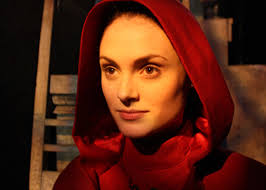
 Offred is the narrator and the protagonist of the Handmaid's Tale. As of now we've seen Offred holds her own individuality. She's not a crybaby like Janine or no an out and out rebel like Moira. She is strictly manipulating her world in the little ways she can for example, when she was out shopping and she makes eye contact with the Guardian even though Guardians are stricly forbidden from looking at Handmaid's. Also when she's playing Scrabble with the Commander and she knows it is not the right thing. We see right away that every character in the Handmaid's Tale does not follow by the rules and so we ask ourselves why do they set rules in the first place if they aren't being used the right way.
Some facts to Offred for example her age, hair color, height are mentioned in the book but she doesn't mention her eye color. Weird huh? In the end, eye color can't mean the same thing to everyone. It is based on your personal experience and on your past. For example if Luke's eyes were to be brown Offred would look at someone else's brown eyes and be able to associate them with that time of sweet, innocent, carefree.
Offred is the narrator and the protagonist of the Handmaid's Tale. As of now we've seen Offred holds her own individuality. She's not a crybaby like Janine or no an out and out rebel like Moira. She is strictly manipulating her world in the little ways she can for example, when she was out shopping and she makes eye contact with the Guardian even though Guardians are stricly forbidden from looking at Handmaid's. Also when she's playing Scrabble with the Commander and she knows it is not the right thing. We see right away that every character in the Handmaid's Tale does not follow by the rules and so we ask ourselves why do they set rules in the first place if they aren't being used the right way.
Some facts to Offred for example her age, hair color, height are mentioned in the book but she doesn't mention her eye color. Weird huh? In the end, eye color can't mean the same thing to everyone. It is based on your personal experience and on your past. For example if Luke's eyes were to be brown Offred would look at someone else's brown eyes and be able to associate them with that time of sweet, innocent, carefree.
 Offred is immediately attracted to Nick.
Offred thinks of him as a suspicious character in the beginning of the novel.
Offred is immediately attracted to Nick.
Offred thinks of him as a suspicious character in the beginning of the novel.
This suggests she is attracted to Nick for many reasons. We witness him stepping on her foot at the ceremony in Chapter 14 of the book. He keeps flirting with her and making her feel paranoid.
"He's too casual, he's not servile enough. It may be stupidity, but I don't think so. Smells fishy, they used to say; or, I smell a rat" she says.
In this quote, Offred describes how Nick keeps putting his foot next to hers. She describes this with great detail. Nick is always trying to interact with Offred, one way or another. Offred describes it as a warm and soft feeling in her foot. By the end of Chapter 17 Nick sneaks into her room and they kiss violently. They both know how dangerous this can be for both of them so they don't go too far. I think Offred has a little something towards Nick that by the end she will completely loose herself and completely ignore the laws. That is my thinking. But I also know she suggest that she can be rebel as well. Offred's awkward affair with Nick is an odd development.
Being with Nick is entirely different than playing Scrabble with the Commander. I can see they gain power within themselves.
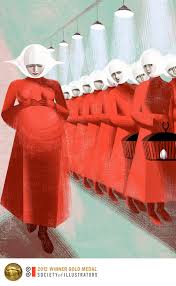 "Sterile. There is no such thing as a sterile man anymore, not officially. There are only women who are fruitful and women who are barren, that's the law."
The problem is that they put steribility on woman and that it is there fault all of the time, never the man. Aside from that, there are even worse circumstances to this. Death is literal if you don't have at least one kid in the Republic. But it is hard for the girls though! Some men are sterile and it is not there fault. The childless woman won't just suffer, they can die.
Another quote,
"The stains on the mattress. Like dried flower petals. Not recent. Old love; there's no other kind of love in this room now."
This quote is very relevant to Chapter 10 because there are signs of depression Offred shows. The sign og love depresses her because she will never love again. Very sexually maybe?
This suggests she is very careful she might see something that can give her hope things will change. Imagery is important in this quote as well. This quote offered a metaphor that compares how there were stains from long ago sex which took place nowadays not evern a bond between two individuals.
"Sterile. There is no such thing as a sterile man anymore, not officially. There are only women who are fruitful and women who are barren, that's the law."
The problem is that they put steribility on woman and that it is there fault all of the time, never the man. Aside from that, there are even worse circumstances to this. Death is literal if you don't have at least one kid in the Republic. But it is hard for the girls though! Some men are sterile and it is not there fault. The childless woman won't just suffer, they can die.
Another quote,
"The stains on the mattress. Like dried flower petals. Not recent. Old love; there's no other kind of love in this room now."
This quote is very relevant to Chapter 10 because there are signs of depression Offred shows. The sign og love depresses her because she will never love again. Very sexually maybe?
This suggests she is very careful she might see something that can give her hope things will change. Imagery is important in this quote as well. This quote offered a metaphor that compares how there were stains from long ago sex which took place nowadays not evern a bond between two individuals.
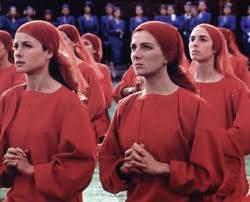 The Handmaid's outfit is all red which I think symbolizes energy, desire, and love. People generally are attracted to red clothing. For example we see this with Offred when Luke stares and winks at her. It might symbolize attraction and want. Their outfit is very significant to this story because it suggest uniform and a dystopian society. It also suggests the blood of the menstrual cycle and childbirth. Within Chapter 5-8 we are introduced to the Wall a very symbolic object where dissidents are executed and hung up on outer walls of the university as a warning to people in Gilead what their actions can cause. There daily duties are the same every day. They serve their commander and follow rules. The Handmaids are very similar to the flowers Offred describes several times in the book. She emphasizes how a Handmaid is like a flower where they have been cut of from the sexual influences of the world. Like when Offred cuts of the sexual organs of the flower. In Chapter 5 we have a lady who is pregnant that makes all the girls very jealous. Offred cannot help but stare at this heavily pregnant lady.
I find interesting that people in this society have everything hidden and don't show there real selves. Woman get jealous like every human does. Woman here also find it very hard to control themselves and their feelings. Many just want to turn against woman. Handmaid's social function is to bear children for Wives.
The Handmaid's outfit is all red which I think symbolizes energy, desire, and love. People generally are attracted to red clothing. For example we see this with Offred when Luke stares and winks at her. It might symbolize attraction and want. Their outfit is very significant to this story because it suggest uniform and a dystopian society. It also suggests the blood of the menstrual cycle and childbirth. Within Chapter 5-8 we are introduced to the Wall a very symbolic object where dissidents are executed and hung up on outer walls of the university as a warning to people in Gilead what their actions can cause. There daily duties are the same every day. They serve their commander and follow rules. The Handmaids are very similar to the flowers Offred describes several times in the book. She emphasizes how a Handmaid is like a flower where they have been cut of from the sexual influences of the world. Like when Offred cuts of the sexual organs of the flower. In Chapter 5 we have a lady who is pregnant that makes all the girls very jealous. Offred cannot help but stare at this heavily pregnant lady.
I find interesting that people in this society have everything hidden and don't show there real selves. Woman get jealous like every human does. Woman here also find it very hard to control themselves and their feelings. Many just want to turn against woman. Handmaid's social function is to bear children for Wives.
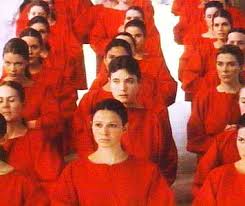 Through out the Chapters 1-4 the lives of woman are strictly ruled and we find out later in the chapter that the narrators name is Offred. Woman are not allowed to talk to each other but they communicate through whispering and body languages. Two woman in authority of them are Aunt Elizabeth and Sara. Marthas wear green uniforms and Wives wear blue uniforms and the woman in red are handmaids. Strange huh? This all goes back to the term we discussed in class called dystopia. A dystopia is a community that is frightnening and undesirable like this society for example.
The story starts out with unfamiliar names such as Angels, Commanders, and Handmaid. Woman hear there names and are reminded that they are no more than a company. Offred no longer has a family nor kids. She has flashbacks to and from the past. Offren works as a handmaid at the household of the Commander and Serena Joy where in chapter 3 where Offren looks around for the Commander's Wife and does not see her but she notices the garden. She uses tons of imagery to emphasize her feelings towards it. She wonders if scarves ever get used. Why do Wives do so much knitting?
I found interesting that men in this society like Luke for example don't go by the rules. He winks at Offred therefore disobeying the rules to not talking to woman. Offred also does what she is not supposed to and flirts with some young Guardians by making eye contact and cherishing his body language. Also we see the word "Handmaid" used in Chapter 4 for the first time.
Through out the Chapters 1-4 the lives of woman are strictly ruled and we find out later in the chapter that the narrators name is Offred. Woman are not allowed to talk to each other but they communicate through whispering and body languages. Two woman in authority of them are Aunt Elizabeth and Sara. Marthas wear green uniforms and Wives wear blue uniforms and the woman in red are handmaids. Strange huh? This all goes back to the term we discussed in class called dystopia. A dystopia is a community that is frightnening and undesirable like this society for example.
The story starts out with unfamiliar names such as Angels, Commanders, and Handmaid. Woman hear there names and are reminded that they are no more than a company. Offred no longer has a family nor kids. She has flashbacks to and from the past. Offren works as a handmaid at the household of the Commander and Serena Joy where in chapter 3 where Offren looks around for the Commander's Wife and does not see her but she notices the garden. She uses tons of imagery to emphasize her feelings towards it. She wonders if scarves ever get used. Why do Wives do so much knitting?
I found interesting that men in this society like Luke for example don't go by the rules. He winks at Offred therefore disobeying the rules to not talking to woman. Offred also does what she is not supposed to and flirts with some young Guardians by making eye contact and cherishing his body language. Also we see the word "Handmaid" used in Chapter 4 for the first time.
 Prospero in Act 4 is very fatherly like. He is too over protective. Nevertheless he issues them a warning. If Ferdinand takes Miranda's virginity before their ceremony, their union would be cursed. Ferdinand, of course, swears he won't do anything not until the day of their ceremony. Prospero calls upon Ariel to perform one of his last acts of magic. Prospero's decision to let Ferdinand and Miranda marry was made even before Ferdinand came into the island. Miranda's virginity is very important. Why? Back in their time, a woman's virginity was so golden that it was important it gained a great deal of power throughout her reign. So Prospero tried his best to keep Miranda well informed of her importance. Prospero suggest that while he keeps Miranda's virginity he will be able to get back to Italy and gain back his power. If Miranda's virginity is thrown away, then Prospero's greatest hope of regaining his position is gone too so he is very careful with Miranda. Don't you see? He keeps her hidden. She has no idea there are more people out there in the world than Ferdinand and her father. Prospero keeps Ferdinand warned as to the consequences to his actions.
Prospero uses a metaphor to compare his daughter to something "rich" to exchange. Prospero's metaphors could be meant to distract Ferdinand from what Prospero and Miranda are getting in the bargain.
Prospero in Act 4 is very fatherly like. He is too over protective. Nevertheless he issues them a warning. If Ferdinand takes Miranda's virginity before their ceremony, their union would be cursed. Ferdinand, of course, swears he won't do anything not until the day of their ceremony. Prospero calls upon Ariel to perform one of his last acts of magic. Prospero's decision to let Ferdinand and Miranda marry was made even before Ferdinand came into the island. Miranda's virginity is very important. Why? Back in their time, a woman's virginity was so golden that it was important it gained a great deal of power throughout her reign. So Prospero tried his best to keep Miranda well informed of her importance. Prospero suggest that while he keeps Miranda's virginity he will be able to get back to Italy and gain back his power. If Miranda's virginity is thrown away, then Prospero's greatest hope of regaining his position is gone too so he is very careful with Miranda. Don't you see? He keeps her hidden. She has no idea there are more people out there in the world than Ferdinand and her father. Prospero keeps Ferdinand warned as to the consequences to his actions.
Prospero uses a metaphor to compare his daughter to something "rich" to exchange. Prospero's metaphors could be meant to distract Ferdinand from what Prospero and Miranda are getting in the bargain.
 Prospero has everything under control! He wanted revenge right? Well, he really doesn't give that.
I think Prospero's actions in the final act reveal his true character. Prospero actually forgives. He makes up his mind about revenge and makes a speech that signifies his formal rejection of magic. Prospero charges Alonso for throwing Prospero and his daughter out of Italy, and Sebastian and Antonio for being part of this crime. Prospero announces Ariel's freedom and Ariel sings a song out of joy. Prospero's judgement on his enemies generally have been justified. Gonzalo was always a honorouable man. Caliban, Stephano, and Trinculo are too drunk to even get punished. But Prospero's character is changed in the last act so much he forgives those that gave him wrong. Caliban apoligizes Prospero for taking Stephano's foolishness and Prospero acknowledges Caliban and takes him as his own.
Prospero's first words suggest a metaphor, the words "gather to a head" suggest things coming to a cimax.
There are also a ton of allusions Prospero puts in his speech such as "green sour ringlets". These ringlets are small circles of sour grass caused by the roots of toadstools, made by fairies dancing.
When Prospero at last confronts Alonso and his brothers, he uses another metaphor to demonstrate the gradual process of Prospero's spell fading from them. Prospero gives up his magic something ironic in this act. A major theme running though the entire work is forgiveness versus vengeance.
Prospero has everything under control! He wanted revenge right? Well, he really doesn't give that.
I think Prospero's actions in the final act reveal his true character. Prospero actually forgives. He makes up his mind about revenge and makes a speech that signifies his formal rejection of magic. Prospero charges Alonso for throwing Prospero and his daughter out of Italy, and Sebastian and Antonio for being part of this crime. Prospero announces Ariel's freedom and Ariel sings a song out of joy. Prospero's judgement on his enemies generally have been justified. Gonzalo was always a honorouable man. Caliban, Stephano, and Trinculo are too drunk to even get punished. But Prospero's character is changed in the last act so much he forgives those that gave him wrong. Caliban apoligizes Prospero for taking Stephano's foolishness and Prospero acknowledges Caliban and takes him as his own.
Prospero's first words suggest a metaphor, the words "gather to a head" suggest things coming to a cimax.
There are also a ton of allusions Prospero puts in his speech such as "green sour ringlets". These ringlets are small circles of sour grass caused by the roots of toadstools, made by fairies dancing.
When Prospero at last confronts Alonso and his brothers, he uses another metaphor to demonstrate the gradual process of Prospero's spell fading from them. Prospero gives up his magic something ironic in this act. A major theme running though the entire work is forgiveness versus vengeance.
